Stars Swallowed by Black Holes: What do these ‘Tidal Disruption Events’ Look like?
Sam Veiner – April 14, 2025
The process of a large body of mass entering a black hole can sometimes take a violent outcome, if the parameters of the situation is correct.
The ‘tide’ portion of the tidal disruption event references the enormous gravitational tidal force created in close vicinity to a black hole. When a stellar mass is well within the black holes gravitational reach, the gradient of gravitational force between the mass of the star which is closest to the hole and the mass of the star which is farthest from the hole can become so large that the star’s gravitational force holding itself together can be overcome by the tidal force. When this happens, the star is torn apart by the force gradient in a process which is scientifically named ‘spaghettification,’ as the mass of the star is pulled into a thin line similar to a spaghetti noodle.
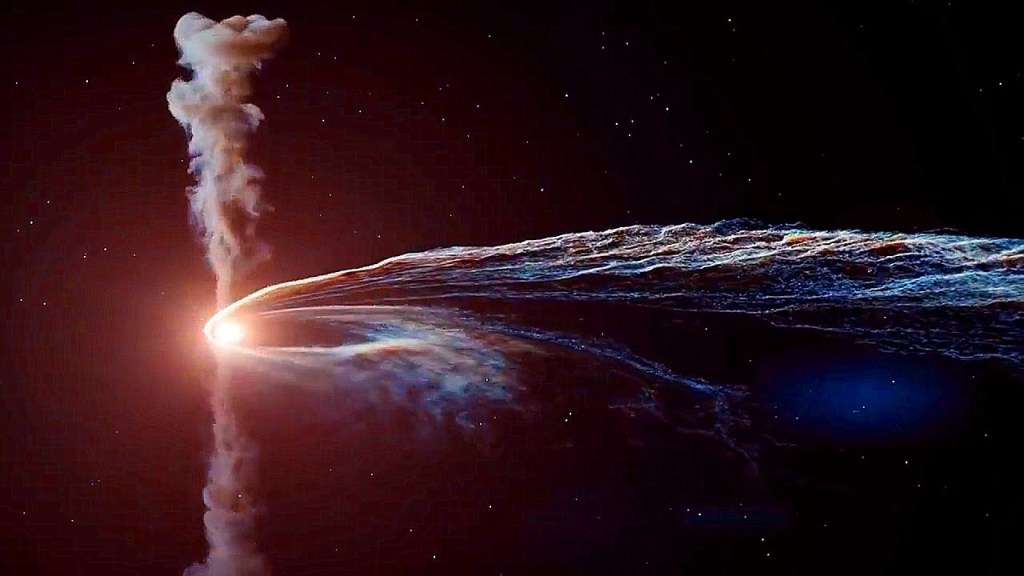
In the photo above, the original star mass was at the end of the large tail, spaghettified by the extreme tidal forces of the black hole in this computer simulation.
To qualify as a tidal disruption event, however, a more specific situation is required- more than just the spaghettification of a star. a stream of mass from the torn star needs to form an accretion disk – a close-proximity, high velocity disk of matter orbiting the black hole. Tidal Disruption Events can be detected here on earth by the radiative effects of the accretion disk in its initial formation – an extremely large amount of energy is released in electromagnetic radiation and heat, which we can detect the spike from earth. So far, around 100 TDE’s have been detected by its electromagnetic radiation.
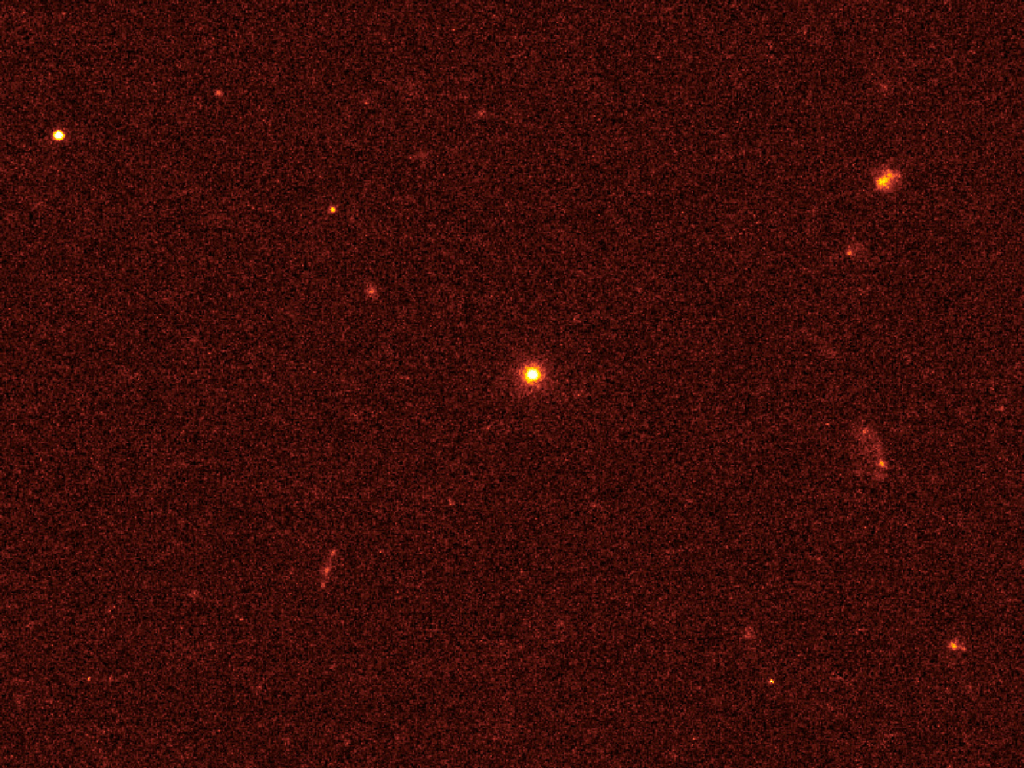
High-power computer simulations are being used to predict these events, since all we can see is a bright flash of light from the accretion disk formation on earth.
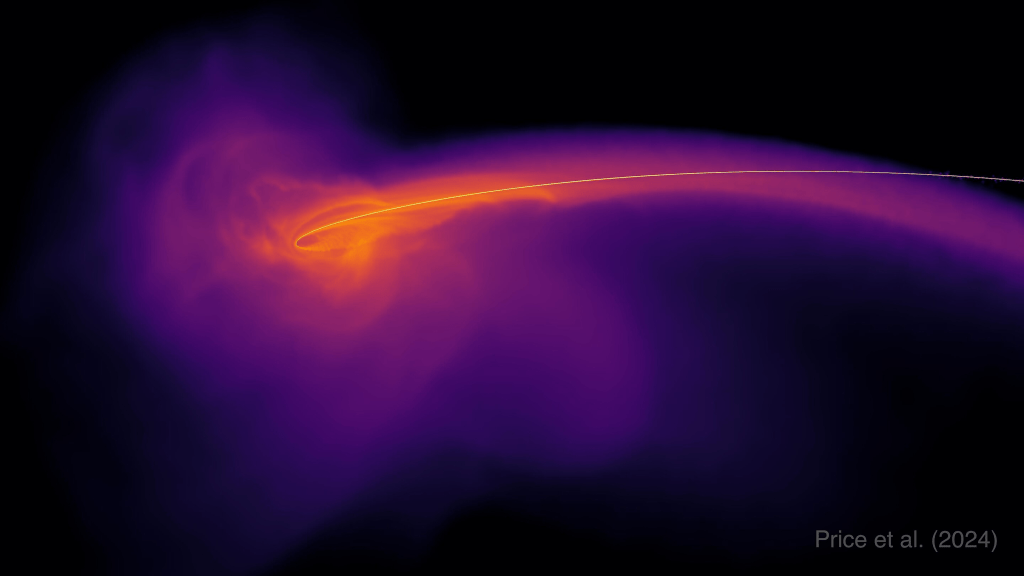
The mass from the star is moving fastest, highest energy, nearest to the black hole, responsible for the flash of light detectable on earth. These simulations need to base the physics through Einstein’s theory of general relativity, due to the extreme gravitational forces and high speeds of mass in a TDE. Newtonian mechanics cannot accurately describe spacetime curvature in these extreme conditions as an approximation of force – Einsteins theory is required to simulate these conditions. Mapping out the gravitational field geometrically with Einstein’s theory is our best bet at understanding what happens in the a Tidal Disruption Event.
 Lust for Stardust