Einstein’s Famous Equation: What Does E = mc² Even Mean?
Sam Veiner – April 11, 2025
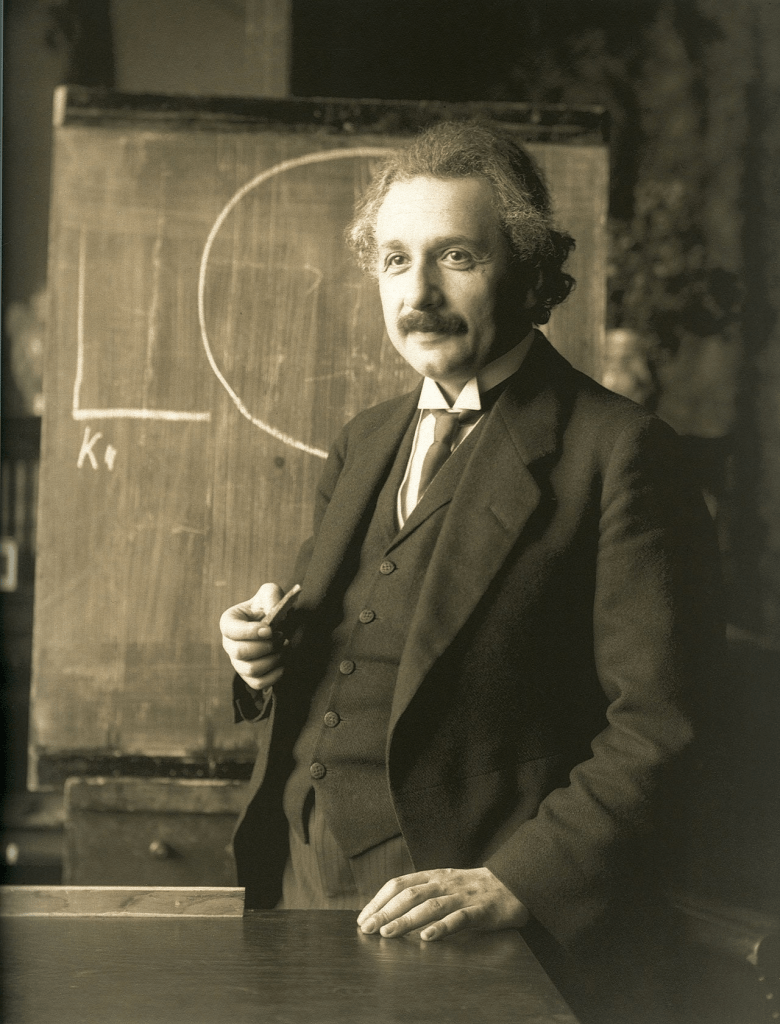
The vast majority of people are familiar with Einstein’s famous equation, and believe that the equation is an example of his ‘smartest man’ status. The very same, people, I have found, also have no clue why the energy-mass equivalence equation was so groundbreaking and fundamental to our understanding of the universe.
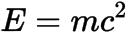
- E is the term which represents energy, (its quantity)
- m is the term which represents mass (its quantity)
- c is the term which represents the speed of light in a vacuum.
In full – The quantity of energy is equal to the quantity of mass multiplied by the square of the speed of light in a vacuum.
The speed of light portion of the equation is really just a constant, an unchanging value in the equation, so we can disregard that portion (which just gives us the correct exchange rate, per se) when asking what the equation really tell us. In effect, Einstein is saying that energy and mass are equivalent and interchangeable. Mass can be energy, and energy can be mass.
Because the value for the speed of light squared is so large, the formula implies that only a small amount of mass corresponds to a large amount of energy. Examply: nuclear reactions and the atomic bomb. It is known that the total mass of the bomb decreases after the detonation – If you were to gather up all of the pieces and particles and gasses that the bomb was created from, you would have less than before the detonation. That mass difference has been transformed into a great deal of energy in the forms of light, sound, and heat.
Only a kilogram of mass would yield 1017 Joules of energy – a preposterous number. The energy mass equivalence Means that mass is nothing more than greatly condensed energy. If an isolated box of ideal mirrors could contain light, the individually massless photons would contribute to the total mass of the box by the amount equal to their energy divided by the speed of light squared.
In short, Einstein said that mass, and mass can be energy, and that mass contains, (even without chemical energy or other potential energies or kinetic energy) a intrinsic large quantity of energy.
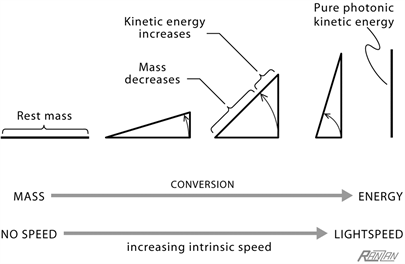
The diagram above shows the conversion pasth of mass into energy, which in order to become pure photonic (light-form) kinetic energy, must gradually lose its mass until it is massless, at which it travels at the speed of light. Mass is the width, kinetic energy is height.
 Lust for Stardust